
FoodCycler®

Food Composter
Odorless, sealed, mess-free. No bugs, pests, or rodents.
Low odor if managed well. Attracts bugs, pests, and smells.
Same-day food waste reduction. Only 4–9 hours.
Months to a year.
On-demand.
3 simple steps.
No pickup or drop-off required.
Needs to be turned regularly.
In-home (on countertop or hidden in cabinet). Compact and considerate on space, even for small apartments or condos.
Outside. Backyard needed.
Year-round.
Cold weather may interfere.
A wider range of food scraps, including meat, dairy, and bones.
Plant-based food scraps and bread/oat products.
Nutrient-rich soil amendment.
Nutrient-rich soil amendment.
Low. Reduced methane significantly when used at home.
Low. Reduces methane when done correctly.
Traditional Composter: A typical food composter acts as an at-home ecosystem that supports and speeds up the growth of microorganisms that decompose organic waste and turn it into compost.
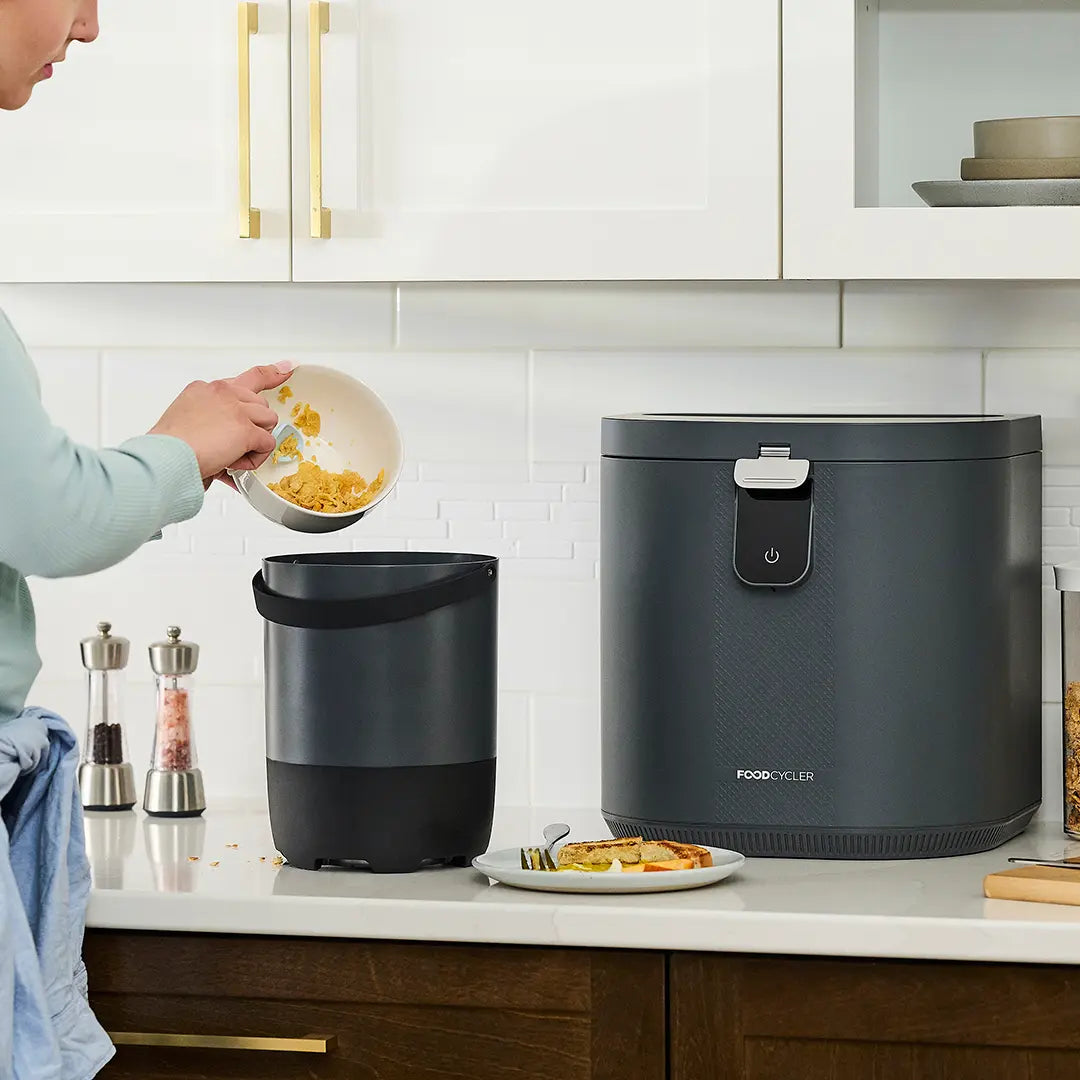
Food Waste Recycler: The FoodCycler uses heat and a rotary blade that is part of our patented Vortech® technology to remove the moisture from food waste and then grind it into a dry, organic-rich byproduct that can be used as a nutrient-rich soil amendment.
Food waste recycling is when you turn food scraps into an eco-friendly material that can be reused or disposed of ethically.
Whether you use a FoodCycler or a food composter, reducing the amount of food waste in landfills is a powerful way to mitigate climate change.
Food waste is the most common landfilled material in the United States.
48% of food waste comes from homes.
When that landfilled waste decomposes, it turns into methane, which is 80 times more harmful than carbon dioxide.
Globally, food waste directly causes up to 10% of greenhouse gas emissions.
When comparing the speed of a FoodCycler vs. a compost, FoodCycler is the undeniable winner!
FoodCycler: Takes 4-9 hours to completely transform food waste into what we call Foodilizer®.
Food Composter: Typically takes 3 months to 1 year for decomposition, depending on how well the pile is maintained.
The FoodCycler can handle the vast majority of organic food waste, with the exception of large, hard bones (beef bones), candy and gum, and oils and fats.
Check this guide for details: What to Feed Your FoodCycler.
When choosing between a food recycler vs. a composter, it’s important to note that composters will attract critters and are not able to process bones, shells, meat, dairy, and other hard or fibrous materials. Furthermore, some types of waste may disrupt the ecosystem’s balance.
While a typical food composter is usually fed continuously, a food recycler, such as the FoodCycler, operates on a batch-by-batch basis. Therefore, once a cycle completes, you can load it right up again!
Let’s break it down:
The Eco 3™ can hold up to 3.5 liters of food waste at a time. The Eco 5™ holds up to 5 liters.
A full cycle takes 4-9 hours, allowing for 2-6 cycles per day.
For 2 cycles, the Eco 3 can handle at least 3.5-7 liters of food waste per day, and the Eco 5 can handle 10-15 liters per day, depending on the need.
The Eco 3 uses 0.9 kWh of energy per cycle. The Eco 5 uses 1.5 kWh of energy per cycle.
We can’t speak for other recyclers, but the FoodCycler uses carbon filters that absorb and eliminate odors.
When comparing the FoodCycler vs. composts, be aware that composters can produce an unpleasant odor, especially with less-than-ideal anaerobic conditions.
The major downsides are the potential odor, pests being attracted to decomposing food waste, and the long decomposition time. The FoodCycler tackles these pain points and provides food waste solutions that are easy and efficient.
In our humble opinion, the FoodCycler is the best way to dispose of food scraps. It offers similar benefits to a food composter, but without the drawbacks.