University Dining
Food waste management was already part of the university's sustainability strategy, but the existing system had become more complicated than convenient. A large, centralized setup required slurry tanks, pumps, and supporting infrastructure, making it difficult to maintain and even harder to scale across campus.
By replacing that system with a single FoodCycler FC-75 installed directly where food waste is generated, the university created a cleaner, quieter, and more practical approach to managing organics. The pilot has already identified two additional campus locations for future deployment, helping shape a decentralized model that can grow alongside the university.
1
Compact FC-75 replacing a centralized system
4
Typical processing drawers per day
6,000 gal
Holding tank eliminated
2
Additional campus sites identified for expansion
Before FC-75
|
After FC-75
|
"Cleaner, quieter, and much easier for staff to use."
— Site team feedback
How the site uses the FC-75
One Machine. Right Where the Waste Is Created.
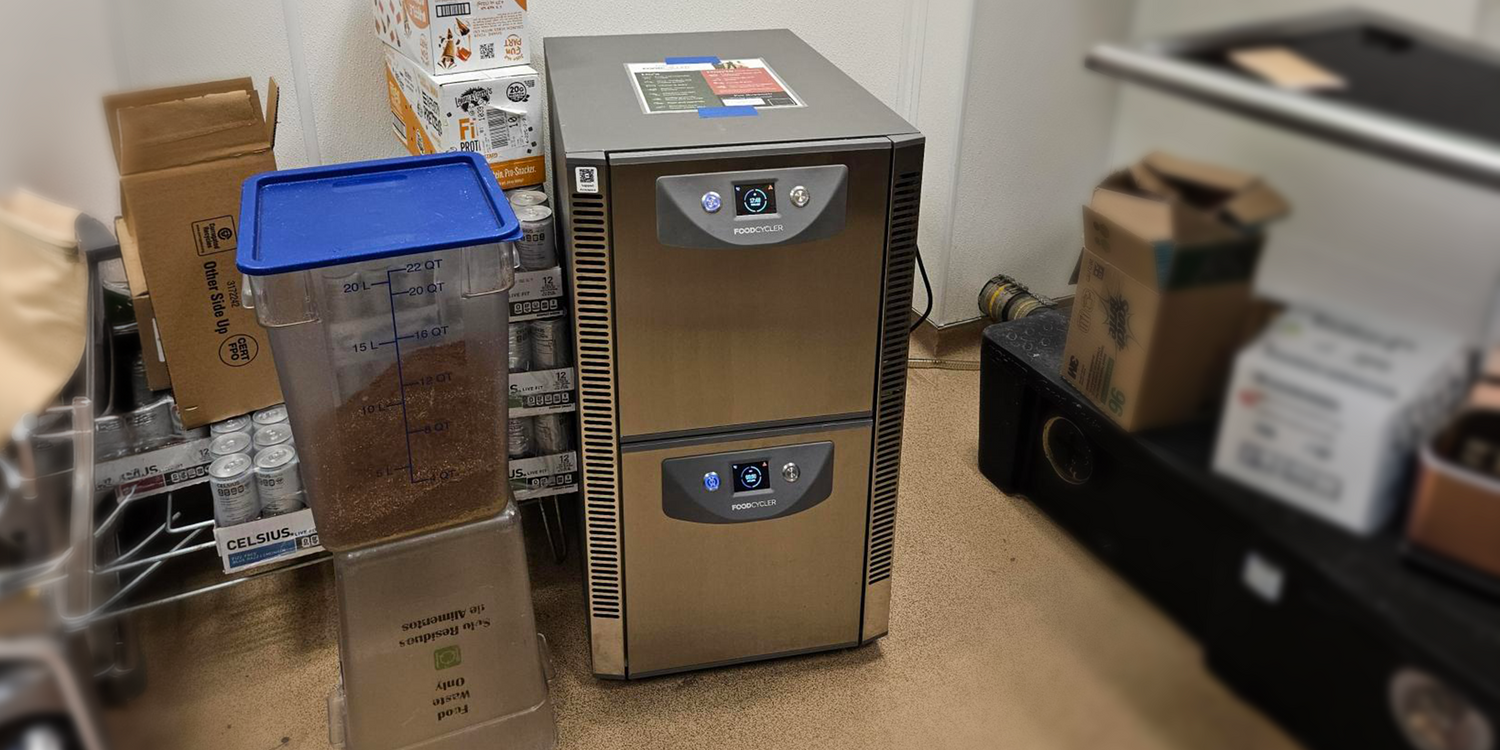
The FC-75 sits in the food preparation area in the Food Hall, where the staff process food waste as part of their normal kitchen routine.
The unit typically runs four drawers each day, with both drawers operating twice during regular service. Current inputs include unsold packaged food and surplus food from service stations.
Instead of transporting food waste through a centralized system, staff process it at the source, reducing handling while simplifying the overall workflow.
The resulting Foodilizer is collected in totes for seasonal use on campus, with future plans to support greenhouse operations and landscaping projects.
Three Reasons This Story Resonates
1. It Simplified an Overbuilt System
Rather than relying on pumps, slurry tanks, and specialized infrastructure, the FC-75 delivers the same operational goal with a compact unit that fits directly into the kitchen.
2. It Fits the Way Campus Kitchens Actually Work
By processing food waste where it's generated, staff avoid moving organics across the facility and can easily incorporate the machine into their existing routines.
3. It Creates a Model That Can Grow
The success of the first installation has already led the university to identify two additional locations, demonstrating how decentralized food waste processing can expand one dining hall at a time.
Best-Fit Customer Profile
- Universities and colleges with multiple dining locations
- Campuses with established sustainability or zero-waste initiatives
- Food service operators looking to eliminate large waste infrastructure
- Organizations interested in using Foodilizer on campus for landscaping or greenhouse projects
- Institutions seeking a scalable approach that can be replicated across multiple buildings
A Simpler Path to Campus-Wide Waste Reduction
Start Small. Scale Naturally.
Rather than investing in another centralized system, they chose to begin with a compact solution that could prove its value in a real kitchen.
The pilot demonstrated that food waste could be managed with less equipment, less space, and less effort while still supporting the university's broader sustainability goals.
With two more sites already identified, the FC-75 is helping build a decentralized strategy that can expand as campus needs evolve.
Beyond the Kitchen: Supporting a Circular Campus
The benefits of the FC-75 extend beyond simplifying food waste management.
By processing food waste where it is generated, they have created a cleaner and quieter kitchen environment while reducing its reliance on large support infrastructure. The Foodilizer produced on site also creates opportunities to return nutrients back to campus through seasonal landscaping and future greenhouse applications.
For universities balancing sustainability goals with practical day-to-day operations, this demonstrates that sometimes the most effective solution is also the simplest. One compact unit has replaced an infrastructure-heavy system while laying the foundation for a more flexible, campus-wide approach to food waste management.